
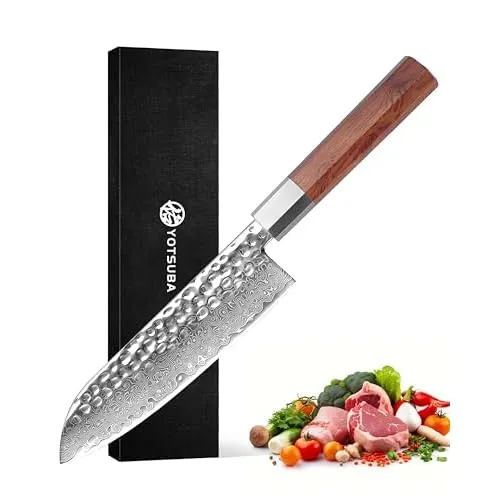
Example set
3PCS Damascus Knife Set
Three-piece Japanese-style set—8" chef, 7" nakiri, and 5" utility—with 67-layer Damascus high-carbon steel (~62 HRC), ~2 mm blades, anti-stick grooves, and an octagonal olive-wood handle. Gift-boxed.
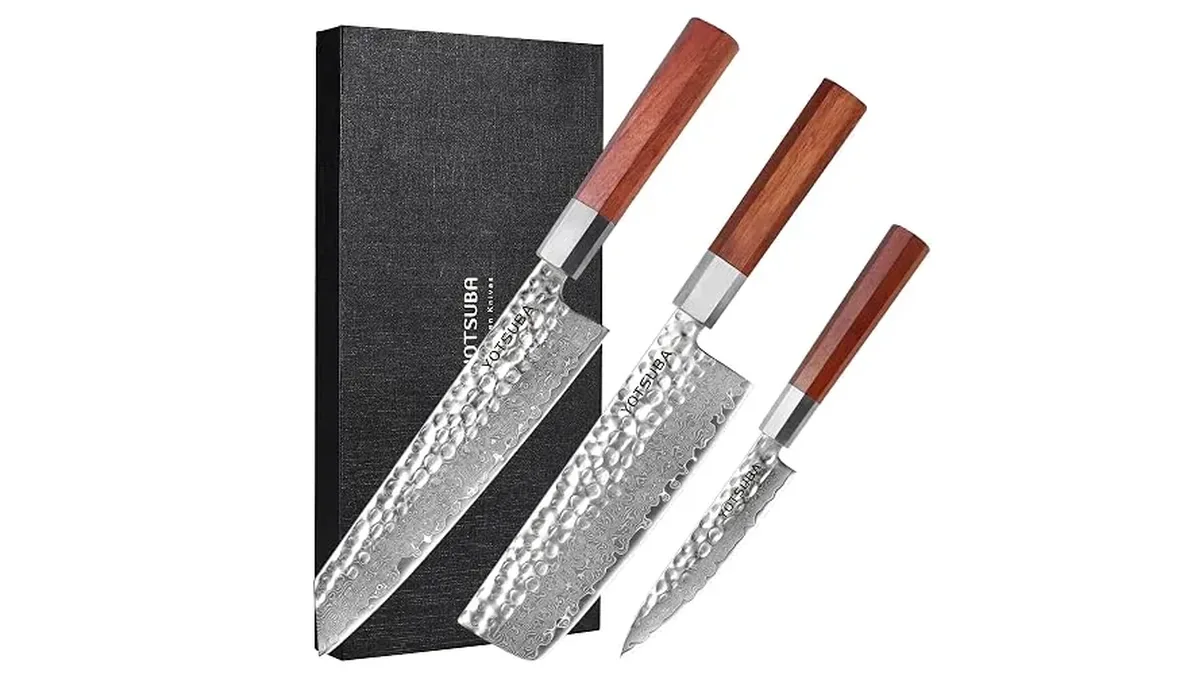
Example set
Three-piece Japanese-style set—8" chef, 7" nakiri, and 5" utility—with 67-layer Damascus high-carbon steel (~62 HRC), ~2 mm blades, anti-stick grooves, and an octagonal olive-wood handle. Gift-boxed.
A Damascus knife doesn't need a ritual. It needs you to drop a few habits most of us learned on cheaper knives: the dishwasher, the soak in the sink, the drying rack. The layered pattern is part of the blade's finish, and the steel is usually harder than a typical kitchen knife, so those habits show up on it faster.
This checklist uses the 3PCS Damascus Knife Set as the example. It's an 8" chef, a 7" nakiri and a 5" utility in 67-layer Damascus high-carbon steel, rated at about 62 HRC, with blades around 2 mm thick and octagonal olive-wood handles. The care advice comes from the knife-care guides named below.
The heat, the detergent and the long wet cycle are hard on the blade, and harder on a wooden handle. Made In, which sells olive-wood knives of its own, warns that wood dries out in a dishwasher and can crack in a way regular oiling won't fix. ForgeGrain's Damascus guide says the same about the blade.
✓ Instead: wash by hand with warm water, a little mild soap and a soft sponge. Wipe from the spine toward the edge, never along the edge.
A knife left soaking stays wet for as long as the dishes do. ForgeGrain says never to leave a Damascus knife soaking or wet, and Made In says the same about wooden handles. A blade hidden under suds is also easy to grab by accident.
✓ Instead: wash and dry it as soon as you finish cutting, before it joins the pile.
Drying is the step that actually protects the steel. Water left to evaporate leaves spots along the line where it sat, and it hides in the joint where the blade meets the handle.
✓ Instead: towel-dry the whole knife right away, blade, handle and that joint included. Then put it away.
Acidic foods react with high-carbon steel. ForgeGrain tells you to rinse soon after cutting citrus, tomatoes or onions, and the UK knife shop Toolsmith notes that acidic food on a high-carbon Damascus blade can darken the surface quickly.
✓ Instead: give the blade a quick wipe or rinse between jobs when you're working through a pile of tomatoes or lemons, not only at the end.
Abrasive pads scratch the finish, and ForgeGrain warns that steel wool and heavy abrasives can damage the pattern.
✓ Instead: use a soft sponge for daily washing. For a small rust spot, ForgeGrain suggests a paste of baking soda and water rubbed on gently with a soft cloth, then a rinse, a thorough dry and a thin coat of oil. If rust keeps coming back or the steel looks pitted, ask the maker or a professional about refinishing rather than sanding it yourself.
Glass, stone and marble boards dull an edge quickly. Seisuke Knife, a Japanese knife shop in Portland, adds that bamboo and glass boards are hard enough to chip a Japanese-style blade.
✓ Instead: use a wooden or soft plastic board.
Hardness is a trade-off. Seisuke explains that harder high-carbon steels hold the sharpest edges but are more fragile: instead of bending, they hold until they can't and then chip. At about 62 HRC, the Damascus set sits at the hard end. Seisuke's rule of thumb is to avoid anything harder than a raw potato, so no bones, frozen food, winter squash or coconut. Twisting the blade in a cut, prying with it or scraping food off the board with the edge all stress it too.
✓ Instead: push-cut through food, scrape with the spine, and keep a tougher knife for the hard jobs. Seisuke notes that softer steel tends to dent rather than chip. Yotsuba's 7PCS Rosewood Knife Set is rated at about 56 Rockwell, well below the Damascus set, which makes it the more forgiving pick if chips worry you.
Loose in a drawer, the edge knocks against other metal and the tip can chip.
✓ Instead: give each knife a protected home. A knife block works if both the knife and the slot are dry. A magnetic strip works if you set the spine on first and lower the blade gently. Jayger, a Damascus knife maker, advises against keeping a blade in a leather sheath for long periods, since leather holds moisture against the steel. If you'd rather have a countertop home with a sharpener built in, see our Knife Block Sets & Rosewood Family page.
Wood dries out over time, especially with frequent washing. Made In suggests a few drops of food-safe mineral oil on a clean cloth, buffed into the handle, then left a few hours to soak in. It recommends doing this at least twice a year, or whenever the handle feels dry. Jayger warns against olive and other cooking oils for long-term protection because they can turn sticky or smell over time.
✓ Instead: keep a small bottle of food-safe mineral oil for the handle. The same oil works on the blade. ForgeGrain treats a thin film after cleaning as optional, but worth it in a humid kitchen or before storing the knife for a while. Wipe off the excess so you're left with a film, not a coating.
Most of the list comes down to four things you do after cooking:
If you're still deciding whether a patterned-steel set suits the way you cook, our Yotsuba 3PCS Damascus Knife Set review covers who it fits, and Damascus 3PCS vs 15-Piece Block sets it against the full block. For every set, block and BBQ blade side by side, start with our Yotsuba review.