Sharpening a Japanese-style knife comes down to a handful of numbers: the angle you hold, how hard the steel is, which grit you use, and how often you bother. Get those right and the technique is mostly patience.
Below are the eight that matter, each tied to the knives Yotsuba makes. The angles and hardness figures come from Yotsuba's own product specs. The sharpening advice comes from guides published by Hamono Direct, AO Sharpening Stones, MADE in JAPAN.JP and Japanese Knife Lab.
14°: the angle Yotsuba lists on its rosewood knives
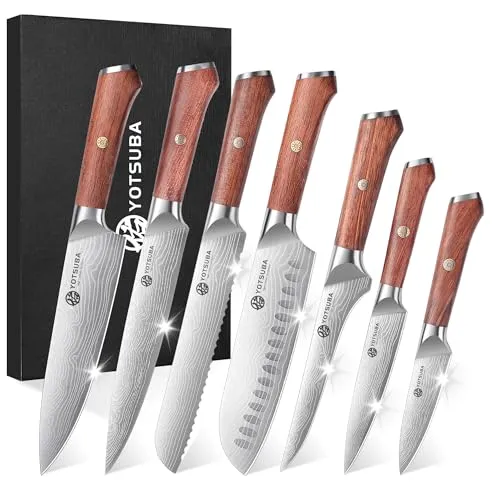
Most Yotsuba rosewood knives give a number for the edge: about 14 degrees per side. That covers the 7PCS Rosewood Knife Set, the 12" brisket knife, the utility and fillet pair, and the 3PCS set with a 7" fillet. MADE in JAPAN.JP's advice is to check a knife's documentation for its original grind angle and sharpen to that. For these knives, the documentation says 14°.
A few knives don't list an angle. The utility and 8" chef pair is one, and for those the general Japanese range in the next sections applies.
14 to 16°: the breaking knife
The 7PCS + 10" Breaking Knife is the one Yotsuba knife with a range. Its carving edges are stated at about 14° per side, and the 10" breaking blade at 14 to 16°. Sharpen the breaking blade within that range and keep the rest of the set at 14°.
12 to 15°: the general rule, and the Damascus set
For double-bevel Japanese knives, which means gyuto, santoku and nakiri shapes, Hamono Direct gives 12 to 15 degrees per side. AO Sharpening Stones says about 15°. Both compare that with roughly 20° per side on a typical German or Western knife, and that lower angle is a big part of why a Japanese blade feels so sharp.
The 3PCS Damascus Knife Set (an 8" chef, 7" nakiri and 5" utility) doesn't give an edge angle, so this is the range to use. Around 15° is a safe middle. If you're unsure which shape does what, our gyuto, santoku and nakiri guide covers it.
56 vs 62: hardness decides your touch-up tool
This is the number most people skip, and it changes what you should do between sharpenings.
Yotsuba's rosewood knives use 5Cr15MoV German high-carbon stainless at about 56 Rockwell. The Damascus set is stated at around 62 HRC, which makes it the hardest steel in the range.
Hamono Direct explains why that matters. Grooved steel honing rods were designed for softer German knives, usually around 56 to 58 HRC. Those edges roll over in use, and a few strokes on a steel push them back into line. Harder Japanese steel, typically 60 to 65 HRC, doesn't roll so much as wear or chip, and banging it against a grooved rod is more likely to chip it.
So in practice:
- Rosewood knives at about 56: by Hamono's reasoning, a honing rod between sharpenings suits them.
- The Damascus set at about 62: skip the grooved steel. Hamono suggests a few edge-trailing strokes on a leather strop, or feather-light passes on a 3,000 or 6,000 grit stone. MADE in JAPAN.JP suggests a ceramic rod held at 15° if you want a rod.
2 coins: finding the angle without a gauge
You don't need a protractor. AO Sharpening Stones, Japanese Knife Lab and MADE in JAPAN.JP all repeat the same rule of thumb: rest the edge on the stone and lift the spine about the height of two stacked coins. That's roughly 15°. AO adds that the true angle depends on how tall the blade is, so treat it as a starting point.
To check yourself, use Hamono's marker trick. Color the edge bevel with a permanent marker and take a few strokes. If ink is left right at the edge, raise the spine a little. If it's left at the top of the bevel, lower it. Hamono also points out that a steady 14° beats a wobbling 12°. Consistency matters more than the exact figure.
1,000 grit: the stone that does the work
If you buy one stone, make it a 1,000. Hamono calls it the stone that restores a dull edge, and AO says it does about 80% of all sharpening. A combination stone with 1,000 on one side and 6,000 on the other is Hamono's suggested starter.
Some stones need soaking. AO says about 5 to 10 minutes, until the bubbles stop. Splash-and-go stones only need water on top, so check which kind you have. Then sharpen one side until you can feel a burr, a tiny rough lip, along the whole edge on the other side. Feel for it by wiping from the spine toward the edge, never along it. Flip the knife and repeat.
3,000 to 6,000 grit: finishing, if you want it
A finer stone replaces the 1,000 scratches with smaller ones. Hamono says many cooks stop at 3,000 for a slightly toothier edge that bites into tomato skins, and go to 6,000 for knives used mostly for slicing fish or meat. AO calls the finishing stone optional.
Whichever you stop at, remove the burr. Hamono's method is alternating strokes with less pressure each time: 10 per side, then 5, then 3, then 1. AO stresses this most for hard steel, because a burr left on it breaks off within days and leaves the edge ragged. That's the Damascus set again.
3 to 6 months: how often to sharpen
Japanese Knife Lab puts a full sharpening at every 3 to 6 months for home use, with honing or stropping in between. A simple test tells you when: slice a sheet of printer paper held in the air, or a ripe tomato. If it catches or slides, it's time.
Two numbers to avoid
20° and coarse grit. MADE in JAPAN.JP says pull-through sharpeners use a fixed 20° angle, wider than the 14° on the rosewood knives, and Japanese Knife Lab warns that pull-throughs can chip harder Japanese steel. Coarse stones, roughly 200 to 600 grit, are for repairing chips, not for a knife that's only dull.
The 15-Piece Knife Block Set has a sharpener built into the block. Yotsuba frames it as a touch-up tool, not a full sharpening system, so keep using a stone for real sharpening.
The numbers, side by side
Swipe sideways to see the whole table →
| Number |
What it means |
Yotsuba knives |
| 14° per side |
Stated edge angle |
Rosewood sets, brisket knife, fillet and utility pieces |
| 14 to 16° |
Stated range for the breaking blade |
7PCS + 10" Breaking Knife |
| 12 to 15° |
General Japanese double-bevel range |
3PCS Damascus Knife Set |
| About 56 HRC |
Softer, honing rod works |
Rosewood family |
| About 62 HRC |
Harder, strop or fine stone instead |
3PCS Damascus Knife Set |
| 1,000 grit |
Main sharpening stone |
All |
| 3 to 6 months |
Full sharpening interval |
All |
To compare blades, sets and blocks, browse Knife Sets or start with our Yotsuba review for the full range.
← More from the Yotsuba Blog