
How to Use a Nakiri Knife
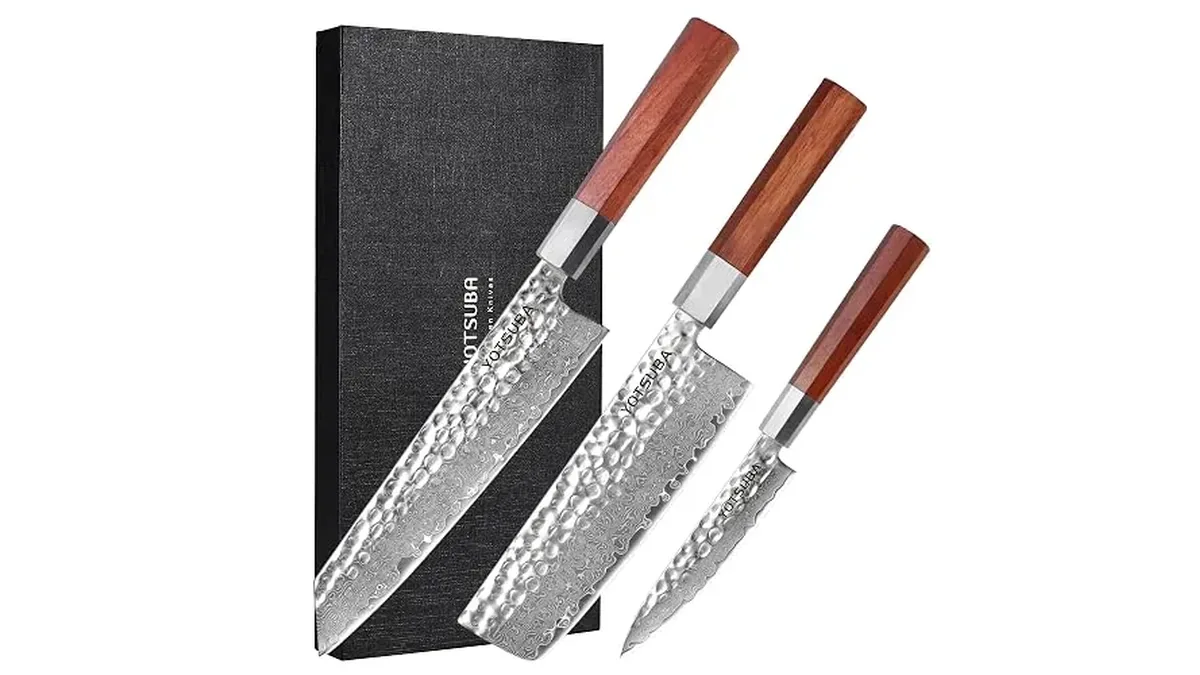
A nakiri looks like a small cleaver, but it's a vegetable knife with a thin blade and a nearly flat edge. That flat edge is the whole point. It meets the board along its full length, so a single downward push cuts all the way through a carrot or a stack of cabbage leaves, with no strings left joined at the bottom.
The 7-inch (178 mm) nakiri in the 3PCS Damascus Knife Set has a blade around 2 mm thick, anti-stick grooves and 67-layer Damascus steel at about 62 HRC. The same length comes in the 15-Piece Knife Block Set, where Yotsuba points to its flat profile for clean push cuts.
Grip
Pinch the blade just in front of the handle between your thumb and the side of your index finger, and wrap the other three fingers around the handle. That pinch is what gives you control over a tall, flat blade. Your other hand holds the food with fingertips curled under, knuckles against the side of the blade as a guide.
The push cut
Forget the rocking motion you'd use with a chef knife. A nakiri doesn't rock, because there's no curve to rock on.
Set the heel of the edge on the food, then push the knife forward and down in one motion until the whole edge touches the board. Lift straight up, move your guiding hand back a slice, and repeat. For softer things like tomatoes, pull back and down instead of pushing.
If you hear the edge clack on the board, you're chopping too hard. The edge only needs to arrive at the board, not hit it.
What it's good at
Cabbage and lettuce. Quarter the head, cut out the core, lay a quarter flat and push-cut thin ribbons. The flat edge means each ribbon comes off whole.
Leeks and green onions. Line up several at once and push-cut across. The tall blade lets you scoop the pile and carry it to the pan.
Herbs. Bunch them tight, slice across, then gather and slice again for a finer chop.
Carrots, celery and cucumbers. Halve lengthwise first so they sit flat and don't roll, then slice.
Squash and sweet potato. These are hard. Cut a flat side first, lay it on that side, and work in shorter push cuts. If a blade starts to wedge, back it out rather than twisting.
What to keep it away from
The 2 mm Damascus blade and 62 HRC steel are what make it slice so cleanly, and they're also why it isn't for bones, frozen food, hard cheese rinds or prying open squash by twisting. Harder steel chips sooner than it bends. Use a heavier knife or a cleaver for those jobs. Cut on wood or a soft board, not glass or stone.
Care
Hand wash, dry it straight away and store it so the edge doesn't touch other metal. Damascus finishes can stain if water sits on them, and our Damascus care guide goes through the habits that cause it.
How the nakiri compares with the santoku and the gyuto is in Gyuto vs Santoku vs Nakiri. Our 3PCS Damascus set review covers the rest of that set.