
How to Use a Santoku Knife
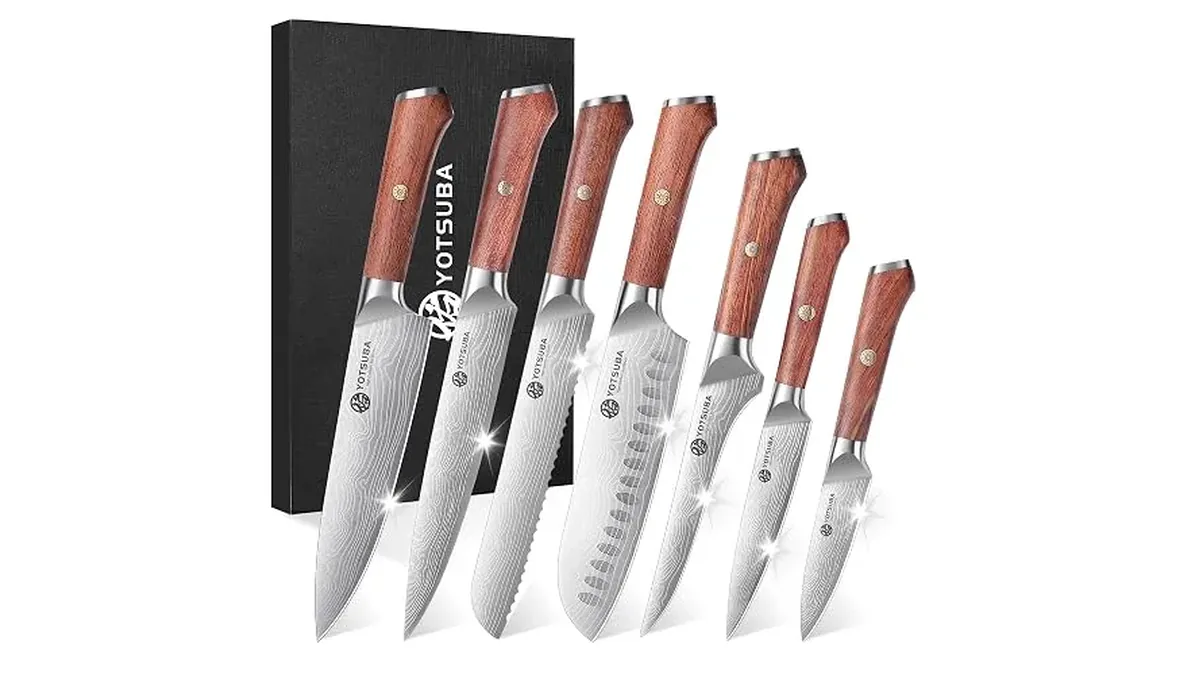
The santoku is the Japanese all-rounder. Its name is usually read as "three virtues," for meat, fish and vegetables. Compared with a Western chef knife, it's shorter, with a flatter edge and a blunt, rounded tip. Those three differences change how you cut with it, so if you use it exactly like a chef knife it'll feel clumsy.
Yotsuba's 7-inch (178 mm) santoku comes in the 7PCS Rosewood Knife Set, the 3PCS Set + 7" Fillet and the 15-Piece Knife Block Set. In the rosewood sets the steel is 5Cr15MoV at about 56 Rockwell, with an edge of about 14° per side.
Hold it with a pinch
Pinch the blade where it meets the handle, thumb on one side and the bent index finger on the other, with the rest of your hand around the handle. Pointing your index finger along the spine feels natural, but it gives you less control over the blade's angle.
Your guiding hand makes a claw: fingertips tucked, knuckles forward, touching the flat of the blade. The knuckles set the slice thickness, and the tucked fingertips stay out of the way.
Three cutting motions
Push cut, the main one. Start with the tip area on the food, then push the knife forward and down so the edge slides through. Finish with the edge flat on the board. Lift, move the claw back, repeat. Most vegetable slicing is this.
Pull cut, for soft things. Start with the heel on the food and draw the knife back toward you as it goes down. Good for tomatoes, raw fish and boneless chicken, where pushing can squash.
Chop, for herbs. The santoku's edge is flatter than a chef knife's, so a long rocking motion doesn't work well. For herbs, gather them tight and do short up-and-down chops with the tip area staying near the board.
Dicing an onion
- Halve the onion through the root and peel it. Lay one half flat.
- Make vertical slices toward the root, stopping short of it so the root holds everything together.
- Make one or two horizontal cuts toward the root.
- Push-cut across. The dice falls away cleanly.
The blunt tip is a little less handy for step 2 than a pointed chef knife, so use the area just behind the tip.
Use the wide blade
A santoku is tall at the heel. Tilt it and slide it under a pile of chopped vegetables to carry them to the pan. Do this with the spine leading, not the edge. Sweeping food across the board edge-first wears the edge down quickly.
Care
Yotsuba's care note for the rosewood sets is short: warm water and mild soap, dry completely with a soft towel, no dishwasher, no soaking. Store it in the gift box or a block so the edge doesn't knock against other knives. When it starts to slide off a tomato skin, it needs sharpening. Our sharpening angle guide covers the 14° edge.
If you're choosing between a santoku and a gyuto or nakiri, see Gyuto vs Santoku vs Nakiri. For larger sets, browse Knife Sets.
Push cuts, scoops and what to leave alone
A santoku shines on push cuts through vegetables and boneless proteins. Guide the tip slightly, keep the heel following, and let the flat face scoop diced pieces off the board into a pan. Rocking chops that work on a Western chef's knife are less natural on a santoku tip; short strokes suit the profile better.
Leave bread, bone-in cuts and frozen blocks for other tools. The santoku is a mid-length daily knife, not a cleaver and not a serrated loaf knife. On Yotsuba pages, confirm blade length and steel notes for the exact parent you buy; this guide teaches motion, not a substitute for the product chart.
Hand and board setup
Pinch the blade just ahead of the handle with thumb and forefinger, wrap the other fingers on the handle, and keep the guiding hand in a claw. Use a stable cutting board with a damp towel underneath if it slides. Wipe the blade between sticky jobs so onion juice does not travel into the next ingredient.
Wash by hand, dry the spine and handle junction, and store the knife in a block, sheath or magnetic strip where the edge cannot knock into other steel. A dull santoku feels unsafe because it needs more force; sharpen on a schedule that matches how often you cook.
Compare Yotsuba profiles in the knife hub on this site before you decide between santoku, gyuto and petty lengths. Open the product page for the live steel and size list when you are ready to buy.
Common beginner mistakes
Gripping only the handle without a pinch on the blade reduces control. Using a tiny unstable board makes every cut feel risky. Letting the edge ride into the board at a steep angle dulls it faster. Fix those three before you buy a second knife. A sharp santoku with a calm grip usually solves more frustration than switching profiles mid-week.