
Yotsuba Brisket Knife: How to Use the 12-Inch Rosewood Carver
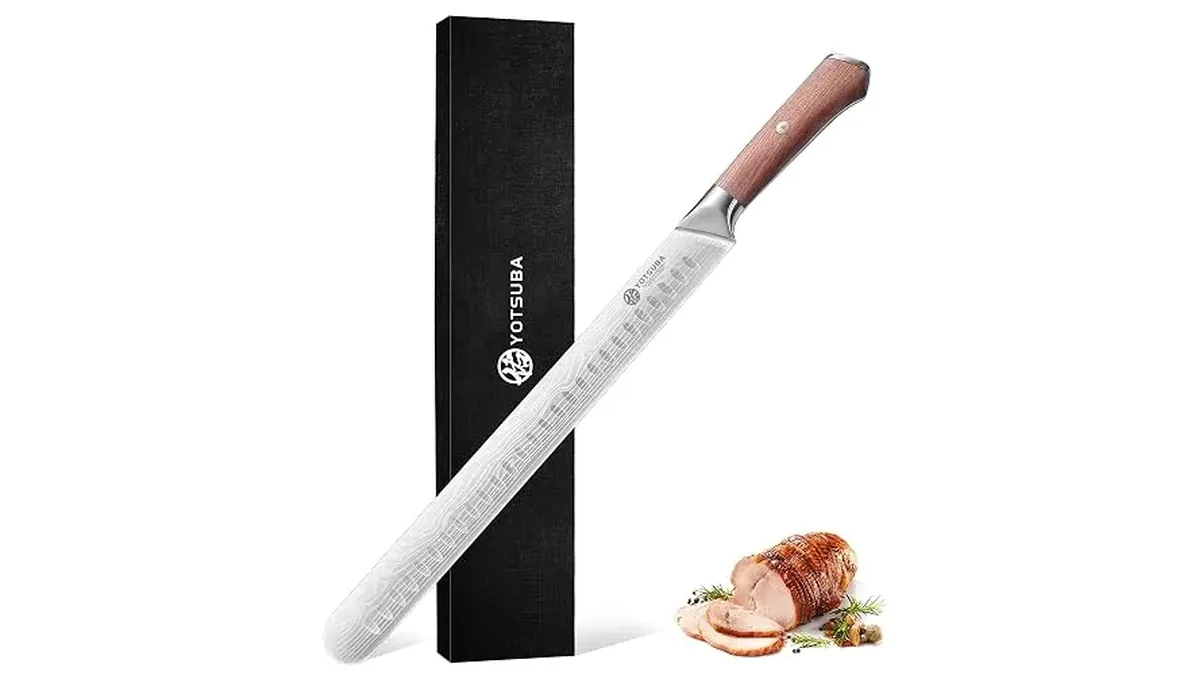
A brisket that took twelve hours to smoke can still get ruined in the last five minutes if you tear it apart with a short knife. Length is the whole point of the 12" Rosewood Brisket Knife. Here's what Yotsuba says the knife is made of, and how to get clean slices out of it.
The knife in numbers
Swipe sideways to see the whole table →
| Yotsuba 12" Rosewood Brisket Knife | |
|---|---|
| Blade length | 12 in |
| Steel | 5Cr15MoV German high-carbon stainless |
| Carbon / chromium | About 0.5% / 15% |
| Hardness | 56 Rockwell |
| Edge | 14° per side, double bevel |
| Handle | Full-tang rosewood, metal frame, colored rivets |
| Comes in | Gift box |
Yotsuba lists brisket, turkey, roast, ribs and prosciutto as the jobs it's made for. The 15% chromium is what Yotsuba credits for resisting rust and tarnish. Cognac Brown is the handle color our Shop now button opens, and the shop page has other colors.
Why 12 inches matters
With a chef knife, the edge runs out partway through a wide slice of brisket flat, so you end up sawing back and forth. Sawing shreds the bark and squeezes juice out of the meat. A 12" blade lets you finish most slices in one long pull, or one push and one pull. That's the motion that keeps the bark on and the slice in one piece.
Slicing a brisket, step by step
- Let it rest first. Cutting straight off the smoker lets more juice run onto the board. Give the meat time while you clear a long cutting board. The tip needs room to travel, so a short board defeats the knife.
- Find the grain. On a whole packer, the flat and the point have grain running in different directions. Look at the muscle fibers before the first cut, because you want to cut across them.
- Separate the point from the flat. Run the blade along the fat seam between the two muscles. A long blade does this in a few smooth strokes.
- Slice the flat across the grain. Keep the tip on the board and draw the full length of the edge toward you. Let the weight of the knife do the work instead of pressing down. Aim for slices about as thick as a pencil.
- Turn the point and slice it. Rotate the point so you're cutting across its grain, too. It's fattier and holds together well in slightly thicker slices.
The same draw stroke works on a turkey breast or a standing rib roast: one long pull, minimal pressure.
Keeping the edge
At 56 Rockwell, this steel is softer than the 62 HRC 3PCS Damascus Knife Set, which makes it quicker to touch up on a hone between cooks. When it needs real sharpening, hold the factory 14° per side. Our guide to sharpening angles for Japanese knives covers how to find and keep that angle.
Care is simple and strict at the same time:
- Wash it by hand with warm water and mild soap.
- Dry it right away with a soft towel.
- Skip the dishwasher, and don't leave it soaking in the sink with the BBQ tools.
Store it back in its gift box between cooks so the edge isn't knocking around in a drawer.
Brisket knife, breaking knife or bundle?
The brisket knife is a slicer for cooked meat. If you're trimming a raw packer or breaking down large cuts before they go on the smoker, that's breaking-knife work. Our brisket, breaking or fillet checklist walks through which blade fits which job.
If you also need weekday prep knives, the 7PCS + 12" Brisket BBQ bundle pairs this same carver with the Milano seven-piece set, all in the same 5Cr15MoV steel.
More long blades for smoked meat are on the BBQ & Carving page.